

Inner Sydney Landscapes : Design, Garden Builder and Programed Maintenance
Get in touch with us at info@new.com
Inner West Landscaping Sydney | Courtyard Garden Builders
The Inner West is not an empty block. Yards are small, already built against the house, and constrained by what sits on every side: a rear lane that will take a barrow and little else, winter shade from a two-storey neighbour, reactive clay under failed concrete, and heritage brick that is to remain.
DC designs, constructs and maintains courtyard gardens for those conditions. The work is measured, built and planted to the lot that exists — not to an acreage template brought in from the edge of the city.
We work through design, council documentation where it is required, construction and ongoing care so the courtyard remains usable after the scaffolding comes down.

Timber and Composite Decking
Decks Designed for Everyday Living
We start with how you actually use the space — morning coffee, kids, entertaining, or a quiet spot off the living room — then design the deck around that.
Each project is planned around the layout of the home, sun and weather exposure, and how the deck needs to work day to day. The aim is a timber or composite deck that feels like part of the house, holds up in Melbourne conditions, and adds lasting value rather than sitting as an add-on.
Quality Materials and Disciplined Construction
From first drawings through to handover, we specify materials for durability, look, and local conditions, then build them with care.
We work with the consultants who prepare documentation and permits, and fold that into a clear construction sequence that meets building standards. Communication on site stays straightforward, so the finished deck performs well, weathers properly, and stays structurally sound over time.

Light the courtyard. Use it after dark.
Decks designed for everyday Sydney living — planned around the home, the weather, and the way you actually use the space.

Timber Vs Composite
Choosing between timber and composite is usually the first real decision on a new deck. Both can look excellent. Both can last. The difference is what they ask of you after the build — and how they handle Sydney’s mix of strong UV, humidity, sudden rain, and, close to the water, salt air.
Timber has been the default for decades. Hardwoods such as spotted gum, blackbutt and merbau give a warm, natural surface that sits comfortably against most Sydney homes. The trade-off is upkeep. In this climate, timber typically needs cleaning and oiling every 12 to 18 months if you want it to keep its colour and stay sealed. Skip that and it greys, checks, and can become more vulnerable to moisture and, in some suburbs, termites.
Composite is made from wood fibre and polymer, designed to look like timber without the same maintenance cycle. Quality boards don’t need oiling or sanding. A wash is usually enough. They resist rot, splinters and termites, and they hold colour more evenly in full sun. The usual costs are a higher price at the start, a more consistent (sometimes less “alive”) appearance, and boards that can run hotter underfoot on a midsummer afternoon.
So the choice is less “which material is better” and more “which one fits the house, the site, and how you want to live on it.” A north-facing coastal deck is a different brief from a shaded inner-west courtyard. Budget works the same way: timber is often cheaper to install; composite often costs less once you count years of oil, labour and the odd board replacement.
This piece walks through look, maintenance, cost, comfort and durability — so you can choose a deck that works for everyday living, not just on handover day.
Timber Decking
Night lighting is what turns a courtyard into an outdoor room you can use after dark. Depth, contrast and a clear path through the garden matter as much as the planting did during the day.
DC uses LED spike lights in garden beds to throw light up the trunk and out through the canopy. A tree, a water bowl or the fire-pit edge becomes the thing you see — not the fitting. Light moving through leaves and branches gives the courtyard depth, makes the space easier to occupy, and sets the tone when people stay outside.
Because the fittings are spiked, they can be placed, aimed and moved as plants grow. All spike lights in this range are 24V DC and need a suitable LED driver. See the LED Drivers page for pairing and capacity.

The Park 20W flood light is a 24V extra-low voltage fitting for broader courtyard and garden lighting — activity areas, lawn edges, pool surrounds and places that need a wider wash than a spike spotlight. An aluminium reflector keeps the output efficient. Warm white 3000K at 1678 lumens. The 24V supply allows thinner cable and cleaner routing through garden beds and along walls. Silver aluminium body, coastal-rated. LED driver sold separately. Price includes supply to Sydney.


Description The Iris 8W RGBW spike spotlight is for a courtyard or garden feature that needs both a classic warm white and, when wanted, colour. Use 3000K for everyday evenings. Switch to RGB when a tree, wall or sculpture should carry a stronger accent. The dark grey body sits in the planting on a 308 mm spike. A 30° beam keeps the light on the subject rather than washing the whole yard. Control is by Wave RGBW remote and receiver, or Casambi Bluetooth mesh from a phone. 24V DC — LED driver sol

The Blaze 36W spike spotlight is the high-power fitting for very large trees. A tight 20° beam carries height and distance with a clean column of light rather than a wide flood. The body is dark grey aluminium, coastal-rated, and sits in the garden bed on a 308 mm spike. Specified at 24V DC so long cable runs can be used with less voltage drop — useful on larger gardens and deep blocks. Warm white 3000K, high CRI, dimmable. LED driver sold separately. Price includes supply to Sydney.

he Karri 20W spike spotlight is for large, mature trees and big garden volumes where a smaller spike will not reach. Powder-coated dark grey aluminium sits back in the planting; after dark it throws a strong, even 45° wash up through the canopy. Use it on substantial feature trees and deeper courtyards that need real output, not just a glow. Warm white 3000K, high CRI, and a coastal-ready body. Runs on 24V DC — LED driver sold separately. Dimmable. Price includes supply to Sydney.

The Willow 11.5W spike spotlight is the high-output fitting in the range — compact in the garden bed, strong enough for large trees. It will comfortably light a canopy up to about 15 metres. The 30° beam reaches height with a tighter column of light. The 60° beam opens out across a broad crown. Specify it for large gums, tall feature trees and courtyards where a 3W or 5W spike will not carry. High-grade aluminium with a TRITEC coating for inland and coastal Sydney conditions. Graphite or black s

The Lotus 5W spike spotlight is for feature trees and courtyard focal points up to about five metres high. Use the 40° beam when you want height up through a canopy. Use the 60° beam when the crown is broad and you need the light to spread. The body is compact — 68 mm diameter × 101 mm high, with a 160 mm spike — so the fitting sits in the garden bed rather than on it. An adjustable head lets you aim the lamp after the planting is in. Graphite or black aluminium.

The Firefly 3W spike spotlight is a small, robust LED fitting for courtyards, garden beds and pots. By day the body sits low in the planting. After dark it throws a warm white beam onto a tree, a piece of stone, or a courtyard feature. The spiked base pushes into soil so the light can be placed, tested and moved without a fixed mount. The head adjusts to aim up into foliage or across a wall. Graphite or black finishes sit quietly against planting and masonry.
In-Ground Lights and Decking Lights
Uplighting changes how a courtyard is read after dark. What sits quietly by day — a stone wall, a trunk, a sculpture, moving water — picks up texture and height when the beam comes from below.
DC uses uplights to give those surfaces a second elevation. Smaller in-ground and deck fittings do a different job. They mark an edge, a step, a path or the line of a deck so movement through the space is clear without flooding the garden.
Together they do two things: they make the courtyard usable after sunset, and they pick out the materials already in the design. Warm, controlled light for walking, sitting and entertaining — not a wash across the whole yard.

The Radius 7W in-ground light is a compact recessed fitting for paths, driveways and stairs. Output is useful; glare is kept down. One-direction is typically set into a stair riser so the wash runs across the face and onto the tread. Two-direction is used along pool edges, alfresco thresholds and staggered steppers — a low guide line rather than a flood. Specified to order. Contact DC for pricing and lead time.

The Nemo 5W in-ground uplight is a recessed fitting for walls, courtyard features and trees up to about five metres. Two beam spreads are available so the same family can run a tighter wash up a wall or a wider throw into planting. 316 marine-grade stainless steel face on an anodised aluminium body for moisture and salt. IK10 rated with a 2000 kg load capacity — suitable for driveways as well as decks, paving and concrete. Not for water features or swimming pools.

The Keo Horizon is a recessed in-ground light with a low dome. Warm white light runs out sideways — one way, both ways, or a wider wash — so stair treads, long steppers, paths and driveways read clearly without glare from above. Sleek enough for a contemporary courtyard, quiet enough for a more classic garden. Stainless steel or black. Must drain from below. Not a pool light. Not for install direct into soil. Price includes supply to Sydney.

The Keo 3W in-ground uplight is a compact recessed fitting for walls, hedges, columns and planting. Place it close to the surface you want to read after dark. Clear glass throws a tighter beam — columns, feature walls and plants. Frosted glass softens and widens the wash — low walls and hedges. Face is a 316 marine-grade stainless steel ring with tempered glass, rated for drive-over. Suitable for decks, paving and concrete.

The Keo 2W in-ground uplight is a recessed fitting for decks, paths and courtyard edges. A 316 marine-grade stainless steel ring and tempered glass sit flush in the surface — unobtrusive by day, a soft glow after dark. Deep frosted glass over a 2W Cree LED gives a balanced wash rather than a hard beam, so it marks a walkway or the edge of a deck without glare. Rated for drive-over use. Price includes supply to Sydney.

The Cluster Mini pathway light is a 1W omnidirectional in-ground fitting. It throws a low 360° glow at foot level — enough to mark a path, a pool edge, a driveway line or a run of stairs without lighting the whole courtyard. Part of the Cluster in-ground family. Body in 316 marine-grade stainless steel, finished in stainless, dark bronze or textured black, so it holds up in coastal and poolside conditions. Specified to order. Contact DC for pricing and lead time.

The Cluster in-ground uplight is a recessed fitting for stone, concrete and timber courtyard walls. The body sits flush in the paving or garden edge so the wall does the talking, not the lamp. A narrow beam and honeycomb lens keep glare down and throw a clean, vertical wash up a pillar or feature wall. Three sizes and three finishes let the same family run from a tight pier to a longer masonry face, inside or out. Specified to order. Contact DC for pricing and lead time.

The Amos 2W in-ground uplight is a small recessed fitting for pillars, courtyard walls and tight architectural details. The lens tilts up to 15°, so the beam can be aimed onto the surface and glare kept off the path and neighbouring windows. Use it where a spike would sit too high or get in the way of paving — the face of a masonry pier, the base of a screen, a niche in a stone wall. Compact, IP65, suited to coastal and urban Sydney sites. Price includes supply to Sydney.
Pond Lights | Pathway & Bollard Lights
A courtyard after dark still has to be easy to walk through. Path lights and bollards sit beside the paving or in the garden bed and throw a low wash along the route — enough to see the ground, a step or the edge of a planter without lighting the neighbours. Most fittings can be aimed along the path or down onto the surface so the beam stays on the walking line. The same light can pick up a plant or object as you pass.
Water is a different kind of light. An underwater fitting in a pond or water feature uses the movement of the surface to throw pattern onto a wall or courtyard floor. Warm white is the usual setting. Amber and RGB are available where colour is part of the design.
Leave the scheme on through the evening: LED fittings are efficient and built for long hours, not seasonal lamp changes. Most path lights, bollards and pond lights in this range are 24V DC and need a suitable LED driver. See the LED Drivers page for pairing and capacity.

The Spectrum is a 600 mm path light with a slim 50 mm stem that reads as a clean line beside paving or a driveway. Textured black aluminium. Built-in 6W LED throws a low, warm wash along the walking line without a hard glare at eye height. Suits formal and simple courtyard layouts. Coastal-rated. 24V DC — LED driver sold separately. Contact DC for pricing.

The Kipos Orb is a slim spike with a small globe for ambient light in a garden bed or beside a path. It marks the planting rather than throwing a beam. Brown powder-coated aluminium stem, acrylic orb. 1.5W, 24V. Two heights: 650 mm or 900 mm, both 45 mm in diameter. Outdoor rated. Long lead time — order with the landscape programme, not as a last-minute add

ob is a short path bollard for tight courtyards, low planting and driveway edges where a tall post would dominate. Height 316 mm, 60 mm diameter, textured black aluminium. Built-in 5W LED behind frosted glass, 110° beam, 3000K. Output is a low marker glow (18 lumens) — enough to read the line of the path, not to light a tree. Coastal-rated. 24V DC — LED driver sold separately.

The Hunza Single Pole Light is a 850 mm stem with one adjustable spotlight. The head rotates 360° and tilts 0–90°, so the same fitting can run a path, pick up a small tree, or aim down to keep light off the vertical plane. Powder-coated aluminium or solid copper. 5W, 24V, 3000K. Head diameter 63.5 mm. Further Hunza finishes (bronze, dark grey, corten, olive green and others) on request.

The Atlas is a cast-concrete ground light. The body sits in the courtyard as a small piece of architecture — warm, low-glare light from a glass face, 200 mm across and 120 mm high. Use it to mark an edge or a path, not to throw a tree. 7W built-in LED, 3000K, 135 lumens, CRI 90. 24V. IP65 outdoor rating.

The Aludra bollard is a simple path and garden light by Jacob Jensen Design. A slim post and cap throw light and shadow along a courtyard path or the edge of a bed. The fitting stands on the included base. Two heights: 454 mm or 954 mm. Seaside-grade finishes in brown metallic, black or anthracite for coastal and inland Sydney sites. Warm 2700K when fitted with a suitable E27 lamp — globe not included. Available as 24V or 240V.
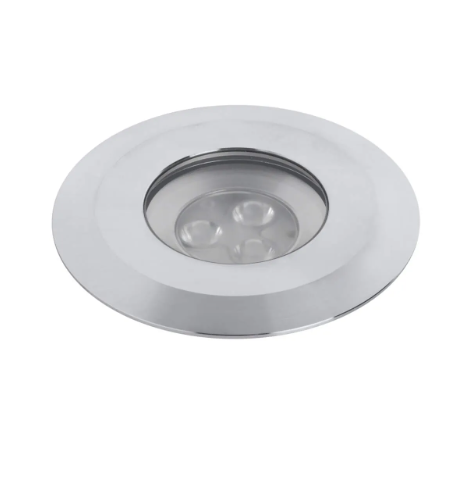
The Pearl 5W is a recessed underwater fitting for ponds, water features and wet walls. The face finishes flush in the wall or floor so the water and the surface do the work, not a lamp sitting on a plate. Full 316 marine-grade stainless steel body for standing water. Cree 5W LED, 60° beam. Use this where a dry garden uplight would fail — and where the Dory’s base-plate mount is not wanted. 24V DC — LED driver sold separately

The Dory 5W pond light is a dedicated underwater fitting for courtyards and garden water features. Marine-grade 316 stainless steel body and base plate for standing water. A Cree 5W LED with a 60° beam lights the bowl or pond and lets surface movement throw pattern onto nearby walls. Supplied with a solid stainless base and 3 m of cable so the lamp can be placed and shifted in the water. Warm white or amber. 24V DC — LED driver sold separately. Not a substitute for a dry in-ground uplight.
Lighting Components & Accessories
A courtyard after dark still has to be easy to walk through. Path lights and bollards sit beside the paving or in the garden bed and throw a low wash along the route — enough to see the ground, a step or the edge of a planter without lighting the neighbours. Most fittings can be aimed along the path or down onto the surface so the beam stays on the walking line. The same light can pick up a plant or object as you pass.
Water is a different kind of light. An underwater fitting in a pond or water feature uses the movement of the surface to throw pattern onto a wall or courtyard floor. Warm white is the usual setting. Amber and RGB are available where colour is part of the design.
Leave the scheme on through the evening: LED fittings are efficient and built for long hours, not seasonal lamp changes. Most path lights, bollards and pond lights in this range are 24V DC and need a suitable LED driver. See the LED Drivers page for pairing and capacity.

Low-voltage joins in the garden fail when moisture travels up the sheath. Solder the cores, cover the joint with a heat-shrink cap, then sleeve the whole join with this outer tube so water cannot wick along the inner and outer insulation. The cap alone is not enough. Heat and cold will still pull a film of moisture along the cable if the outer layer is missing. Done once, properly, the circuit lasts. 1200 mm length, 16 mm diameter. Shrink with a heat gun. Resistant to moisture and soil

The WAVE receiver sits between the 12V or 24V LED driver and the fittings. Pair it with a WAVE remote to switch, dim and — on RGB lamps — change colour without extra wall-switch cable. Works with single-colour and RGB lighting. Use with the WAVE Multi-Zone Single Colour remote or the WAVE Multi-Zone RGB remote. Remotes and receivers are sold separately so each courtyard can have the zones it needs. RF 434 MHz / 868 MHz, typical range 20–30 metres through walls and around corners.

The WAVE remote is an RF handset for switching, dimming and colour on compatible garden lighting. It works through walls and around corners — typical range 20–30 metres on 434 MHz / 868 MHz. One remote can run multiple zones. Remotes and receivers are sold separately so the layout can match the courtyard. Colour fittings get full colour pick, dimming and fade modes. A magnetic wall cradle is included. Powered by three AAA batteries (supplied). A weatherproof receiver is available for outdoor

Casambi is a low-energy Bluetooth mesh system for switching, dimming and colour from a phone, tablet or watch. The free app sets scenes and timers — for example on at sunset, off at 10 pm — without a separate wall clock. This Arditi PWM module has four channels. It will run single-colour, tunable white, RGB or RGBW fittings. On single-colour lamps the four outputs can be four independent zones from one module. At 24V the maximum load is 144W, shared across the channels. Typical range from module

Twin-sheathed two-core low voltage cable for 24V garden lighting. Use the 6 mm cable on runs over about 50 metres so voltage drop stays under control. Shorter runs can use the 5 mm cable. Lay it through garden beds with the lighting plan. Protect or bury it where dogs, tools or traffic can cut the sheath. Not a substitute for the 240V supply cable to the driver. 100 m roll. Also available in 30 m.

The 24V fittings on this site need a driver. This is a Mean Well LPF 60W constant-voltage unit: 240V in, 24V DC out, plastic body, IP67, 1.8 m flex and plug. Add up the wattage of the connected lamps and choose a driver with spare capacity. A 60W unit suits a small courtyard circuit — a handful of path lights or low-watt spikes — not a full tree scheme. Australian safety approvals and C-Tick. Five-year warranty. If the load is unclear, contact DC before ordering

The 24V fittings on this site need a driver. This is a Mean Well HLG 240W constant-voltage unit: 240V in, 24V DC out, metal body, IP67, 1.8 m flex and plug. Add up the wattage of the connected lamps and choose a driver with spare capacity. A larger driver runs cooler, lasts longer, and leaves room to add fittings later. Use this size when the 150W unit is too close to the load. Australian safety approvals and C-Tick. If the load is unclear, contact DC before ordering

The 24V fittings on this site need a driver. This is a Mean Well HLG 150W constant-voltage unit: 240V in, 24V DC out, metal body, IP67, 1.8 m flex and plug. Add up the wattage of the connected lamps and choose a driver with spare capacity. A larger driver runs cooler, lasts longer, and leaves room to add fittings later. Australian safety approvals and C-Tick. Seven-year warranty. If the load is unclear, contact DC before ordering
CONTACT

Inner West, Eastern Suburbs and Upper North Shore Landscape Design, Garden Builder and Programed Maintenance
Inner West
Annandale · Ashbury · Ashfield · Balmain · Balmain East · Birchgrove · Camperdown · Croydon · Croydon Park · Dobroyd Point · Dulwich Hill · Enmore · Haberfield · Hurlstone Park · Leichhardt · Lewisham · Lilyfield · Marrickville · Newtown · Petersham · Rozelle · St Peters · Stanmore · Summer Hill · Sydenham · Tempe
Eastern Suburbs
Vaucluse · Watsons Bay · Dover Heights · Rose Bay · Bellevue Hill · Point Piper · Double Bay · Darling Point · Edgecliff · Woollahra · Paddington · Bondi Junction · Bondi · North Bondi · Bondi Beach · Tamarama · Bronte · Waverley · Queens Park
Upper North Shore
West Pymble · Pymble · Gordon · St Ives · St Ives Chase · Killara · East Killara · Lindfield · East Lindfield · Roseville · Roseville Chase · Turramurra · South Turramurra · North Turramurra · Warrawee · Wahroonga · North Wahroonga